
If you live with a dachshund, you learn fast that personal space is gone. You stand up to grab a glass of water, and tiny paws patter right behind you. You close the bathroom door, and a wet nose starts working the gap underneath. You sit at your desk, and a long warm body curls itself around your ankles like a draft stopper.
If any of that sounds familiar, you have probably asked yourself: why is my dachshund a velcro dog? In the dachshund world, this clinginess has a name — the shadow trait — and it is one of the breed's most defining quirks. Much like burrowing under blankets or flattening into a doxie sploot, shadowing you from room to room serves a real psychological need. It is not a flaw. It is the breed doing what it was built to do.
The Dachshund Shadow Checklist
- The physical anchor: they insist on body contact, leaning their torso against your legs every time you stop moving.
- The micro-movement radar: they track your smallest shifts — one weight change on the couch and their head is up.
- The chosen person: they bypass everyone else in the house to follow one primary human from room to room.
Why Do Doxies Follow You Everywhere?
Dachshunds were bred as scent hounds to work shoulder-to-shoulder with human hunters, tracking badgers and flushing game. That job required total focus on one handler — reading their cues, staying close, never wandering off. Centuries later, that wiring is still there. Your dachshund is not being needy. It is doing the job it was designed for, except the "hunt" is now following you to the kitchen.
There is also a simpler, physical reason. A dachshund sits inches off the ground, and a house full of furniture legs and tall moving humans can feel exposed from down there. Gluing itself to your feet turns you into a moving safe zone. When you understand why doxies follow you everywhere, the behavior stops looking like anxiety and starts looking like strategy.
3 Signs You Own a Textbook Velcro Dachshund
Every dachshund is affectionate. But a true velcro dog takes it further. Here are the three classic signs:
1. The Constant Bathroom Vigil
A regular dog waits for you. A velcro dachshund stages a protest. Closed doors are unacceptable — expect whimpering, pawing at the frame, or a small body planted directly against the door until you come out. It is not about the bathroom. It is about the barrier. To a shadow dog, any closed door is a system failure.
2. The Micro-Movement Awakening
Most dogs sleep through small household sounds. A velcro dachshund sleeps with one ear on you. Shift your weight on the couch, slide your feet into slippers, reach for your keys — and their head pops up instantly. They are constantly pre-reading your trajectory so they never get left behind. Owners joke that their doxie has a motion sensor. It is not far off.
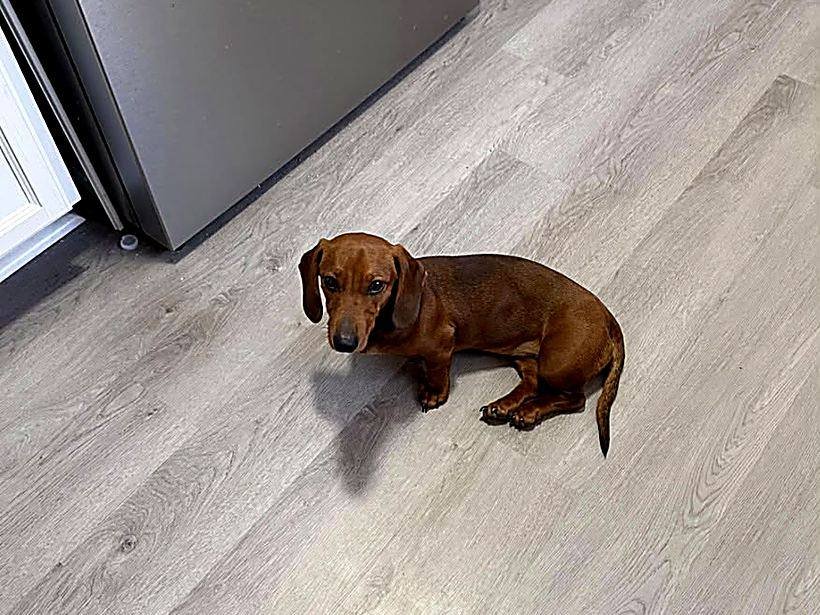
3. The Full-Body Lean
This is the signature move. When you stop walking, your dachshund does not just stand near you — it presses its full side against your calf or drapes itself across your feet. Trainers call this "leaning," and in dachshunds it is practically a love language. The lean says: you are my anchor point. If the lean happens every single time you stand still, you have a certified shadow.
When Velcro Tips Into Separation Anxiety
Here is the line every owner should know: shadowing you around the house is normal. Panicking when you leave is not. A velcro dog that follows you room to room but settles fine when you go out is just being a dachshund. A dog that cannot cope with your absence has crossed into separation anxiety.
Watch for these red flags:
- Destructive chewing, scratching at doors, or house soiling that only happens when you are gone.
- Nonstop barking or howling starting within minutes of your departure.
- Refusing food, treats, or toys the moment you leave the house.
- Escape attempts — clawed window sills, bent crate bars, squeezed-through gaps.
- Excessive drooling or panting when alone that stops the second you return.
If you are seeing these, it is worth talking to your vet or a qualified trainer. Separation anxiety is a genuine welfare issue, not a training failure, and it responds well to structured alone-time work.
How to Give Your Shadow Healthy Boundaries
You do not want to break the bond — the loyalty is the best part of the breed. You just want a dog that can handle a closed door without a meltdown. A few things that actually work:
- Teach "place." A mat or bed where your dachshund earns treats for settling. Start with you in sight, then gradually add distance.
- Practice micro-departures. Step out for 30 seconds, come back calmly, stretch it to minutes. Boring comings and goings teach them that leaving is not an event.
- Feed the brain, not just the bond. Puzzle feeders and snuffle mats in another room give them a reason to be happily apart from you.
- Stop the dramatic exits. Long goodbyes and guilty re-entries teach your dog that departures are a big deal. Keep both boring.
- Never punish the shadowing. Scolding a dog for following you damages trust without teaching anything. Redirect, do not reprimand.
The goal is not a distant dog. It is a confident one — a dachshund that chooses to follow you because it loves you, not because it is afraid to be without you.
- American Kennel Club — Dachshund breed information
- VCA Animal Hospitals — separation anxiety in dogs
- American Veterinary Society of Animal Behavior — position statement on humane training