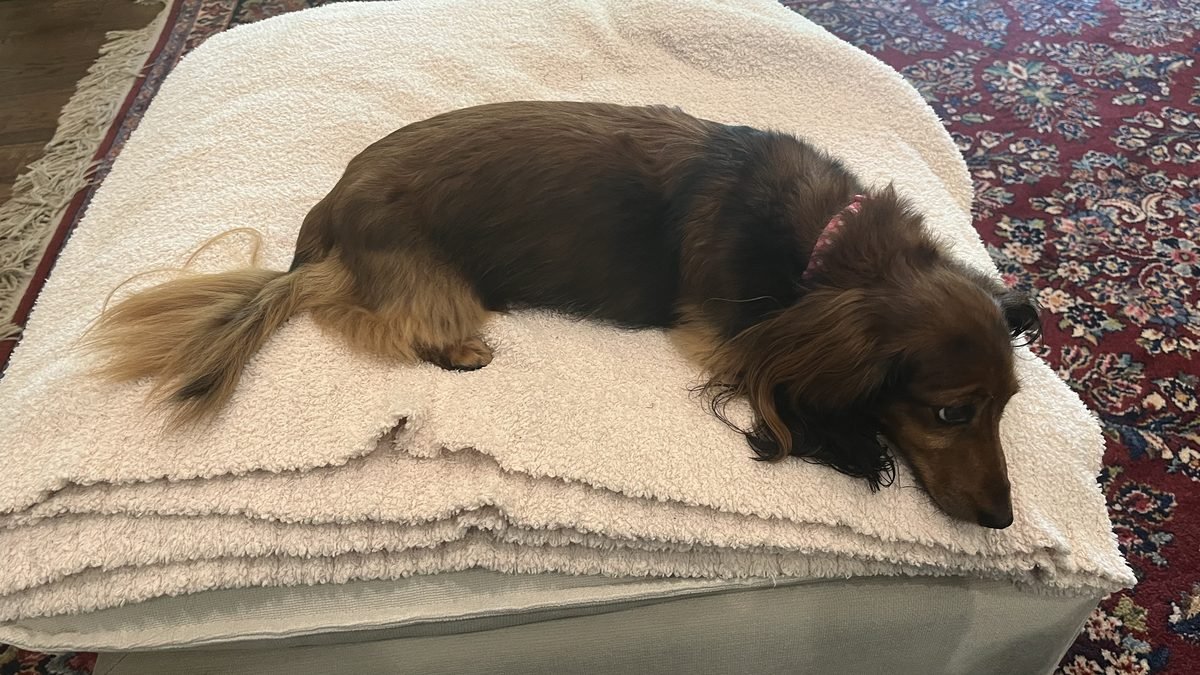
If you own a dachshund, you know the daily routine. You walk into the living room, approach the couch, and notice a mysterious breathing lump in your favorite throw blanket. You peel back the fabric, and a tiny nose pokes out, followed by two big eyes.
For most dogs, hiding under the covers is an occasional habit. For dachshunds, it is a lifestyle. But why do dachshunds sleep under blankets so consistently? It looks like a cute quirk, but it is really a window into your dog's genetics and emotional well-being.
Key Insights for Doxie Owners
- The badger-hunting ancestry: the dachshund burrowing instinct is hardwired from centuries of tunneling underground after badgers in Europe.
- Emotional security dens: enclosed fabric spaces cut sensory overload and give anxious dogs a predictable safe zone.
- Body temperature maintenance: dachshunds sit low to the ground with minimal insulation, so they lose heat fast — especially smooth-coated minis.
Understanding the Deep Dachshund Burrowing Instinct
To answer why doxies hide under covers, trace them back to 18th-century Germany. "Dachshund" literally translates to "badger dog." They were not bred as lapdogs. They were built to be determined hunters.
Their long bodies, paddle-shaped paws, and low center of gravity were selected for one job: diving headfirst into dark, narrow badger tunnels. When your dog scratches at the bedsheets and corkscrews to the bottom of the comforter, that is the same program running. To a doxie, a heavy blanket feels like the walls of a den.
The Psychology of Enclosed Spaces: Why Weiner Dogs Tunnel in Blankets
Beyond hunting ancestry, there is an emotional layer to why weiner dogs tunnel in blankets. Dogs are den animals by nature. Their wild ancestors slept in small, enclosed spaces where nothing could ambush them.
Dachshunds are observant and deeply bonded to their people, so the open space of a modern house can overstimulate them. Tunneling under a fleece blanket builds an instant micro-den: the visual world shrinks, everything becomes predictable, and the nervous system can finally power down into deep rest.
Is Your Dog Seeking Warmth or Security?
Miniature dachshund burrowing behavior is mostly instinct, but environment plays a part. Read their posture inside the blanket:
- The cozy roll: curled loosely, breathing slow, sighs when you peek in. This dog is topping up its emotional security.
- The shiver ball: curled tight and tense, pressed against your legs or a heat vent. This dog is cold and needs thicker fabrics.
- The guarded cave: growls softly or refuses to come out when guests arrive. This dog is self-soothing through social anxiety.
Spine-Safe Burrowing: Protecting Your Doxie's Back
An estimated one in four dachshunds develops intervertebral disc disease (IVDD) in its lifetime. Long spine, short rib cage, fragile discs — the breed's shape is the risk. Your home setup has to respect that.
Never let your dachshund burrow under heavy weighted blankets unsupervised. The weight can trap a small dog and force the sharp twisting motions that rupture discs. Stick to lightweight, breathable fleece, or get an open-front cave bed that allows easy entry and exit.
Read the Burrow: What It Is Telling You
| What you see | What it usually means | What to do |
|---|---|---|
| Slow circling, then settling under a light blanket | Normal nesting instinct | Nothing. Let the badger dog badger. |
| Burrowing into your laundry or worn clothes | Comfort-seeking; your scent calms them | Leave a worn T-shirt in their bed instead |
| Frantic digging, panting, restless | Stress, anxiety, or discomfort | Look for triggers: noise, schedule changes, pain |
| Growling when you reach for the blanket | Resource guarding the den | Trade, do not grab. Train a cheerful "out" cue |
Real Owner Concerns: Answers From the Community
Can a dachshund suffocate under blankets?
This is the number one question in breed groups. The reassuring answer: healthy adult dachshunds move when they get too hot or uncomfortable. They will turn around or poke a nose out for air. Your job is to make that easy — always leave a loose exit route, never tuck them in tightly, and keep heavy bedding out of the burrow equation.
Why does my dachshund growl when under the blanket?
That is localized resource guarding. The blanket has become a high-value comfort asset, and your dog is defending the den. Do not drag them out by force — that escalates the guarding. Lure them out with a high-value treat and reward the exit, so leaving the cave pays better than defending it.
Should I stop my dachshund from burrowing?
No. Suppressing the burrowing instinct causes frustration and anxiety in a breed built to tunnel. Make it safe instead: dedicated light blankets on the couch or floor, heavy items cleared away, and a cave bed of their own. Most doxies adopt the approved burrow within days.
The Blanket Safety Checklist
- Use light blankets and quilts. No weighted blankets for unsupervised burrowing.
- Always leave an exit. Tuck bedding loosely so your doxie can nose its way out.
- Check before you sit. The lump on the sofa is not a pillow.
- Keep young puppies out from under human duvets at night.
- Wash burrow bedding often. Nose-down dogs inhale whatever lives in the fabric.
- Watch for overheating in summer. Panting means the blanket comes off.
- American Kennel Club — Dachshund breed history and standard
- Dachshund Club of America — breed information resources
- VCA Animal Hospitals — nesting behavior and intervertebral disc disease in dogs